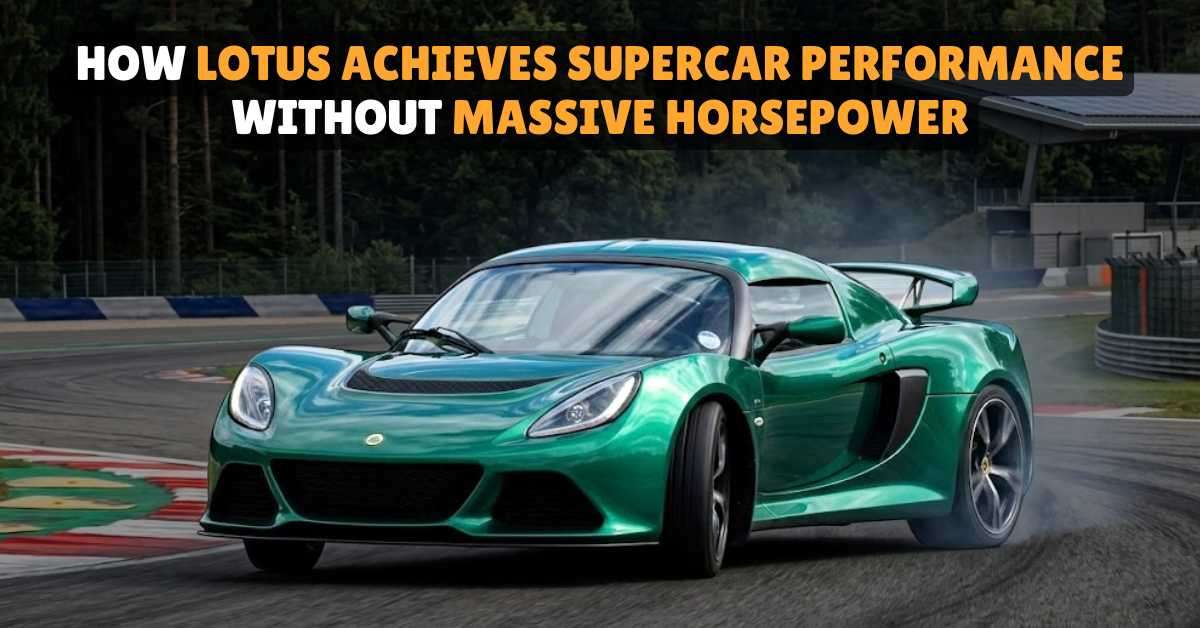
How Lotus Achieves Supercar Performance Without Massive Horsepower
Unlike the car industry's focus on acceleration and horsepower, Lotus has always had a different set of philosophies. Even though many of today's performance cars boast huge engines and heavier weight, Lotus has proven that balance, precision and lightweight engineering make for better driving performance, and that massive engines have little part.
This is what makes Lotus one of the most respected names among driving enthusiasts, track-day drivers and purists, what they are in the world.
The Philosophy of “Adding Lightness”
Lotus founder Colin Chapman was legendary for saying that it was more important to lose weight than add more horsepower to the car. His concept of designing for engineering, which can sometimes be explained as “simplify, then add lightness,” is part of what is still true about Lotus vehicles to this day.
This doesn't just use up more fuel for its fuel consumption, but it actually has several performance benefits:
Faster cornering speeds
Improved braking performance
Sharper steering response
Better chassis balance
Lower stress on tyres and suspension.
Less tyre and suspension stress.
Greater driver engagement
Readily riding the road, instead of owning it, Lotus Cars are designed to blend with it.
That is why many Lotus models can prevail over much more powerful cars on technical roads and race tracks.
Lightweight Engineering Creates Real Performance
As there is a considerable amount of technology that is luxurious, sizeable drivetrains and intricate electronics, along with supercars, are a lot more than 1700 kilograms. However, many Lotus cars keep under onerous curbs significantly lighter as a result of their intelligent engineering and material choice.
Lotus does this by implementing the following:
Lowest in weight aluminum chassis.
Compact vehicle dimensions
Minimalistic interior design
Precision-tuned suspension systems
Simplified unnecessary electronics.
The outcome is an extremely responsive car across all speeds!
Drivers often call driving in a Lotus car “connected” because the car's communications between the driver and the road are so accurate. The only negative is the lack in steering inputs, where many other, more powerful options lag in the responsiveness department, while other departments, like those for corners, stay mostly in the same band as more powerful options, with all of them feeling fairly consistent.
Aerodynamics Over Raw Power
Aerodynamically, Lotus scores well as well because of its special aerodynamic design.
Significant attention has been paid to the optimization of aerodynamics, downforce distribution, and high-speed stability in the course of the development of Lotus cars. Efficient aerodynamics give the car a proper stance to remain planted during intense driving, while also making it extremely accurate to handle.
This is a better engineering solution:
Cornering confidence
High-speed stability
Track consistency
Brake cooling efficiency
Overall vehicle control
If the sports car is well-balanced and lightweight, most of the time, a light car with a few more horsepower presents a wonderfully faster and more fun experience in comparison to a heavy car with a ton of horsepower.
Driver Engagement Is the Real Goal
Lotus vehicles are not meant to make big numbers when tested and impressive figures when viewed on social media. Intended to make the driver and machine a true match.
That's why Lotus remains to this day a hugely adored cult brand in a world of flashy tech-heavy performance vehicles.
All parts of a Lotus are useful. All four aspects of steering calibration, suspension geometry, throttle response and weight distribution have all been carefully considered for their contribution to driver confidence and engagement.
Maintenance quality is thus of critical importance, owing to this philosophy. A good upgrade will retain the driving qualities of Lotus, using genuine parts and carefully engineered upgrades. To uphold the original harmony and exactitude of the vehicle, many vehicle owners focus on obtaining high-quality Lotus car parts instead of trying to acquire unnecessary modifications.
Precision Matters More Than Numbers
It is easy to make money with horsepower and not everyone has a clear understanding of reality.
A lighter, more agile vehicle can very often:
accelerate more efficiently,
brake later,
displays a higher corner speed,
Give quick lap times on technical courses.
Knows that performance is a complete engineering system, not just one number.
That's one reason why the more advanced enthusiasts are often more interested in chassis response, steering response and suspension tuning, as well as the actual horsepower and torque.
Any minor improvement can make a big difference in the handling of a car. Carefully selected Lotus car accessories, from aerodynamic elements to lightweight wheels to interior performance upgrades, are carefully selected to complement the car's engineering rather than to hinder it.
Why Lotus Continues to Stand Apart
With the industry shifting more toward technology and heavier cars, Lotus remains more focused on driver-focused cars.
Thanks to the brand's attention to light construction, handling and mechanical purity, there has been a loyal base of users worldwide who value accuracy over a lot of frills.
But for those who seek a little more in the way of driving thrills and a little less in terms of numbers, Lotus is still one of the few brands that's always a true driver's experience in the cockpit.
At Lotus Parts Direct, enthusiasts can find quality components to ensure the performance, balance, engineering and authenticity of Lotus vehicles on the track and road.